
 Wikipedia: The three Moirai, relief, grave of Alexander von der Mark [de] by Johann Gottfried Schadow (Old National Gallery, Berlin
Fate, Destiny, and the Threads We Weave
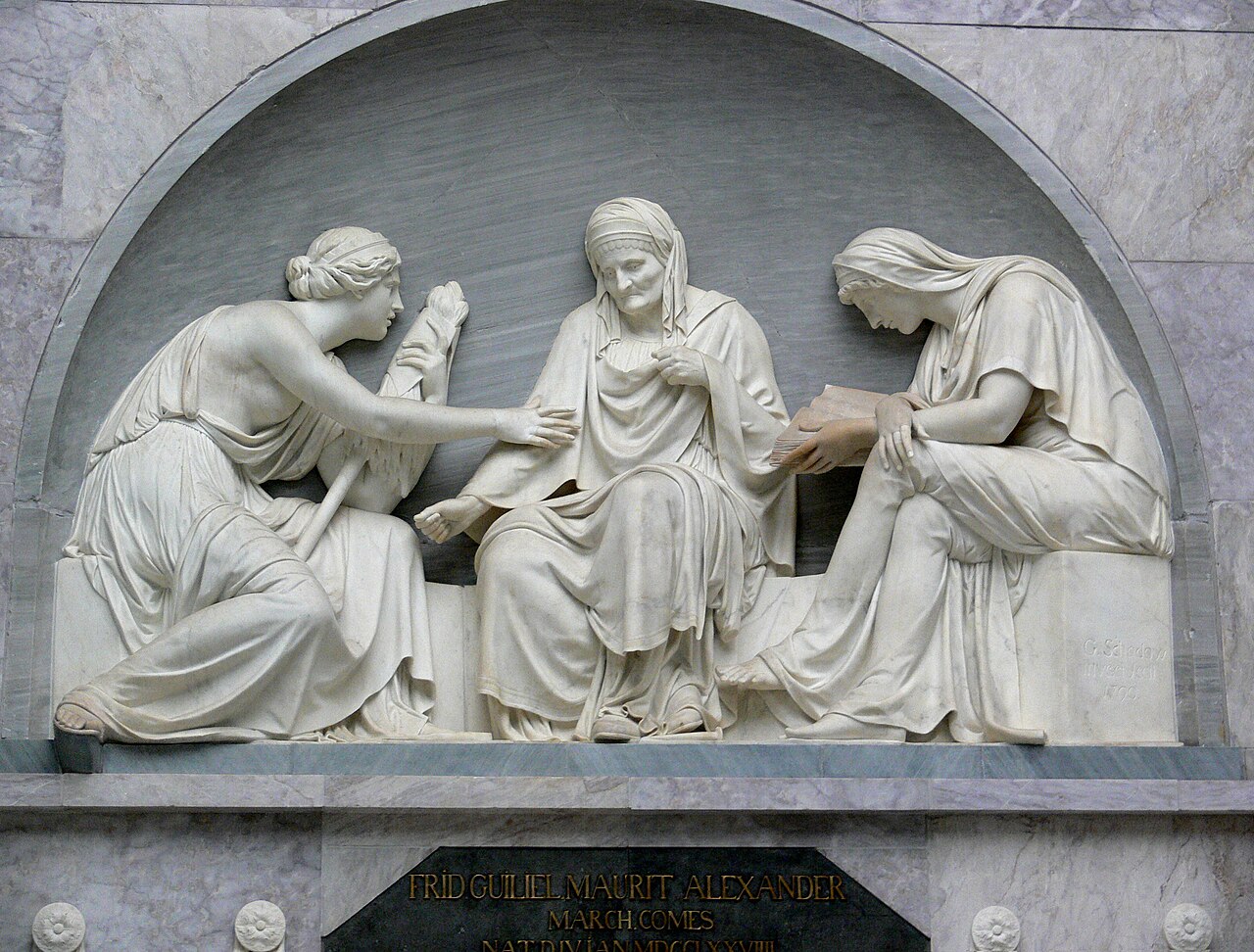
The three Moirai, relief, grave of Alexander von der Mark [de]
by Johann Gottfried Schadow (Old National Gallery, Berlin)
Is our life already written, or do we have a hand in how the story unfolds?
Throughout history, humanity has pondered the mysteries of fate and destiny. Are we born with a purpose already woven into our existence, or do we discover that purpose through the choices and experiences of our lives? Perhaps there is something to consider in both.
In ancient Greek mythology, three goddesses known as the Moirae, or the Fates, were believed to govern the threads of human life. Clotho spun the thread, Lachesis measured and allotted each person’s portion, and Atropos determined when the thread would be cut. Together, they represented the mystery of birth, life, and death. [1]
Yet even within ancient Greek thought, the relationship between fate and human choice was not always clearly defined. Mythology explored the influence of the gods, while philosophers questioned how much control individuals had over their actions. It is an interesting thought that has remained with us through the centuries. How much of our lives is predetermined, and how much is shaped by the choices we make? [2]
I have often wondered whether we arrive in this lifetime with a soul purpose, something like a spiritual mission statement. Not necessarily something we are here to accomplish, but something we are here to understand and eventually embody.
Perhaps that purpose is to come to know compassion, forgiveness, acceptance, unconditional love, or a deeper understanding of ourselves and our connection to others.
If that is so, perhaps destiny is the purpose, while free will determines the journey.
I have found that life rarely follows the road we imagine. We encounter unexpected changes, relationships, loss, and opportunities that influence our direction. Sometimes we make choices that move us forward, while at other times we find ourselves returning to familiar patterns, wondering why certain experiences seem to repeat themselves.
This, to me, is particularly interesting because understanding something does not necessarily mean we have learned to live it. We may understand forgiveness yet continue to carry resentment. We may believe in unconditional love but struggle to extend that same compassion towards ourselves. And we may recognize the importance of acceptance while resisting the very changes unfolding in our lives.
From a spiritual perspective, I also wonder whether one lifetime is always enough. If our soul carries a particular purpose, perhaps that journey continues through many lifetimes, each offering different experiences and opportunities for growth. The possibility of the soul experiencing more than one lifetime is found in various spiritual and philosophical traditions, although interpretations differ. [3]
Yet within this lifetime, as we begin to live what we have come to understand, something within us can shift. What once seemed difficult may become easier, familiar patterns may no longer hold the same influence, and possibilities we had not previously considered may begin to emerge.
Perhaps fulfilling a part of our soul’s purpose is not an ending, but an opportunity for another beginning. After all, change can be one of life’s most rewarding experiences.
Of course, none of us can know with certainty how this unfolds. Nor do I believe we need to assign a spiritual reason to every hardship or loss. Life sometimes simply happens in ways we cannot explain, and we are left to find our own way through.
Is it not so, that even when we cannot change our circumstances, we may still have choices in how we respond.
This is where I find the practice of PAUSE so meaningful. It offers us a moment to become aware of where we are, what we may be holding onto, and whether the direction we are travelling reflects who we are becoming. Not every experience requires an immediate answer or change. Sometimes awareness itself is enough to begin seeing things differently.
With this in mind, perhaps the ancient Greeks were offering more than an explanation of life’s beginning and end. Their image of the thread invites us to consider the mystery of what shapes our existence and what remains within our hands.
Perhaps fate presents the threads, free will guides our hands, and destiny is the greater tapestry that gradually reveals itself.
And perhaps our soul’s purpose is not about reaching a destination, but about coming to embody the very understanding we have been seeking.
A Thought to PAUSE With
What if your soul’s purpose is not something you have yet to achieve, but something you are gradually learning to become? And what new possibilities might open as you do?
References and Further Reading
[1] Encyclopaedia Britannica. Fates — Greek and Roman Mythology. An overview of the Moirae, their traditional roles, and their relationship to human destiny.
https://www\.britannica\.com/topic/Fate\-Greek\-and\-Roman\-mythology
[2] Stanford Encyclopedia of Philosophy. Ancient Theories of Freedom and Determinism. Revised November 19, 2024. An examination of fate, human choice, responsibility, and determinism in ancient philosophy.
https://plato\.stanford\.edu/entries/freedom\-ancient
[3] Plotinus, Enneads. Particularly III.2 and III.4, which explore the soul, its development, and reincarnation. These ancient philosophical teachings provide historical context for the possibility of multiple lifetimes, rather than proof of the author’s spiritual interpretation.
Author’s note: The reflections on soul purpose, spiritual growth, and PAUSE express my personal understanding and beliefs. They are offered as an invitation to reflection rather than statements of established fact.